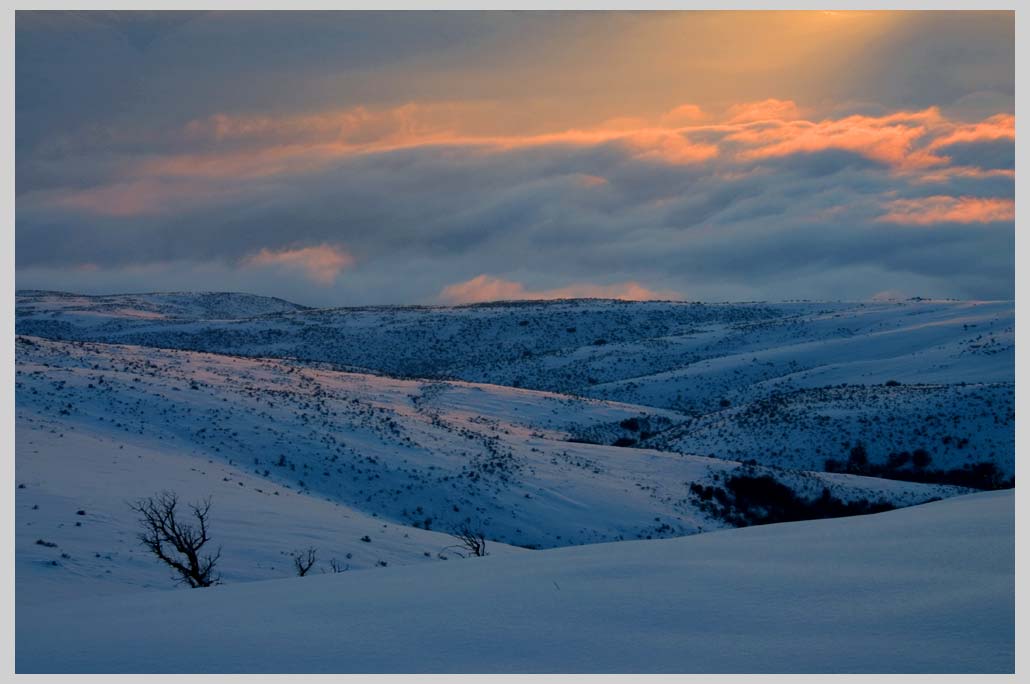
Snowy Sagebrush Steppe, last light, just before New Year's snowstorm . . .
On the road in the American Northwest.
Snowy Sagebrush Steppe, last light, just before New Year's snowstorm . . .
On the road in the American Northwest.
ON THE FRAGMENTATION OF NATURAL
WATER CYCLES
The spring gives freely of its water,
but only in freedom can we drink.
Let me begin by saying that I don’t really know first hand what
a truly large-scale natural water cycle is like, because I have
never lived for a sustained period of time in a culture wholly
nested within one. At the same time, I do know and have extensive
experience with what a natural water cycle is not. And let it
be said from the outset, that I do not like what I see, both in the
parts of the European Alps that I know well, and those areas of
the Northwest that I am presently exploring.
I do not like this recurrent pattern of the radical fragmentation
of natural water cycles: break the flow; dam the river; fill the
reservoir; divert vast quantities of water for frequently questionable,
wasteful ends. Perhaps most importantly, I simply do not
like the folly of attempting to control what is not really understood.
The rich and chaotic complexity of the natural water cycle
has been treated as if it were as neat and orderly and precise
as a Swiss train. And now, only some fifty years after the great
boom time of mega-dams, everywhere the negative side-effects
of the extraordinary hubris of this philosophy of control are
building up before our eyes like piles of unpaid bills.
The facts are unequivocal. In the Reuss / Rhein watershed
of the Alps, where I’ve worked for many years intensively,
the salmon stopped running in 1958; And now, by some very
strange twist of fate, the part of the great Columbia watershed
in which I’m now focusing much of my attention—the South
Wallowas—the salmon also stopped running that same year:
1958. Those are facts.
But in a far more subtle and tragic way, some vast, essentially
unknowable, natural movement has been lost; it has stopped
turning, as it were, as if a heavy wrench were thrown into the
delicate spokes of a finely tuned wheel.
So the movement of the cycle fragments, breaks up into essentially
out-of-phase, partial, disharmonious, smaller half-cycles.
The result is that the entire life-community that depends on this
rhythmic flow of a watershed as a whole begins to suffer—one
species at a time—begins to pull back, decline, dry up, and,
finally, vanish. “Vanish” is not, I believe, an exaggeration here.
In both areas mentioned above—the central Alps and the South
Wallowas—there are at present no real recovery plans for salmon,
which means that they are effectively being erased from
consciousness.
How has this happened? Well, I would say because of confused
meaning.
The basic question is, “What is a river?” Is it something like
a vein or artery of the living Earth? Or is a river more like a
sewer or water pipe, with precise, measureable properties?
These questions of meaning and perspective are more basic
than the facts of objective needs, like water for irrigation, power
generation or human consumption, as important as these might
be. Why? First, because natural limit always trumps need. If
water managers say they need for a town of 5,000 two million
liters of water a day, and the basin provides only one million,
well, the “needs” will just have to change. Full stop. Second, it
is meaning that shapes this all-important perception of natural
limit, just as meaning in turn is shaped by a culture’s primary
formative images or metaphors. If we think of water as money,
for example, then it is clearly a waste of capital to let water
just flow out to sea without making it work for us. So, just like
money, we put water in “banks,” by building reservoirs and
dams. And, just as with money, we act as if there is no natural
limit: more is always better. The crucial flaw, I would argue, in
this water-is-money style of thinking—its essential contradiction—
is that there’s no compound interest when it comes to
water, nothing like the money-begetting-more-money of for
example a 5% loan that hedges against doubling its cash in a
mere 16 years, and that essentially out of thin air! Water behind
a dam, it is true, does build up for a time, but its quality rapidly
degenerates, and the knoting up of the natural flow evidently
invariably sets off a cascade of contradictions throughout the
wider water-based web of life. The water silts up; water temperatures
rise as vital oxygen levels decrease; the thermal weight
of such large bodies of static water may set-off a micro-climate
forcing, raising ambient temperatures enough to melt snowpack
on the higher peaks before that snowmelt is needed, or cause
more precipitation to fall as rain instead of snow; agricultural
pollution is no longer periodically flushed out from the system;
the complex nested rhythms and dynamic balances of the ebb
and flood of the water-year are broken; the macro flows of essential
nutrients from mountain forest to the sea and back again
are destroyed. These are just a few of the facts, not in my view
as it is euphamistically put, “concern,” but rather of collapse.
Contradiction—or how the all-important limits of Nature and
the artifacts of Culture ‘speak or fight against one another’—
has two key features: First, it points to weaknesses in our way
of thinking, or philosophy of design, which are at the same time
happily always new opportunities for discovery; And second,
contradictions are always non-sustainable. That is, opposing
movements grind against each other until the wheels of the system
at some point simply fall off.
This means that, regardless of how we think about them, where
there is contradiction there will be collapse. It is up to us—and
this is the problem’s ethical dimension I think—to use the best
of our science to untie the knots, so to speak, in an intelligent
and measured way, or else be swept away in a highly unpleasant
flood of mostly unforeseen negative consequences.
ON THE NECESSITY OF ROADLESS
AREAS (II)
It is true: once a road is built, it frequently becomes easier and
easier to get to places that are less and less worth going to. If it
can be said that roads have a tendency to bring out the worst in
people—the noisy grind of greed and self-centered haste—then
paths bring out the best, a kind of waste-not-want-not of a
rugged, but increasingly rare spirit of self-reliance. The one, a
sharp-edged knife that rips apart the fabric of forest and meadow;
the other, a single thread which in the walking weaves itself
seamlessly back into the natural world.
Clearly, we obviously need good, well-designed roads. But even
more we need the wisdom of natural limits which tells us when
not to build them.
PHOTOGRAPHY AS MANDALA
A ritual circle which brings the far away, the very small, the
ignored or half forgotten, into the magical middle realm of the
contemplative compassionate eye.
A circle which not just mirrors the Beautiful, but reflects also
the Strange and Ugly through the clear, yet necessarily imperfect
and somewhat blurred lens of partial truth.
TOO MANY VARIABLES
We shape the world and the world shapes us.
To master the complex, keep things simple.
To keep things simple, keep the number of variables
to but a single dial.
Turned all the way down, the dial produces the sleep of rigid
dogma; turned all the way up, it produces the runaway confusion
of random noise.
Better to keep things focused on the
clear limits of the middle way.
| a part of THE LITTLE CLAVIER (pdf only 22.8 Mb)
| to download: Windows: r click; Mac: opt + click |